
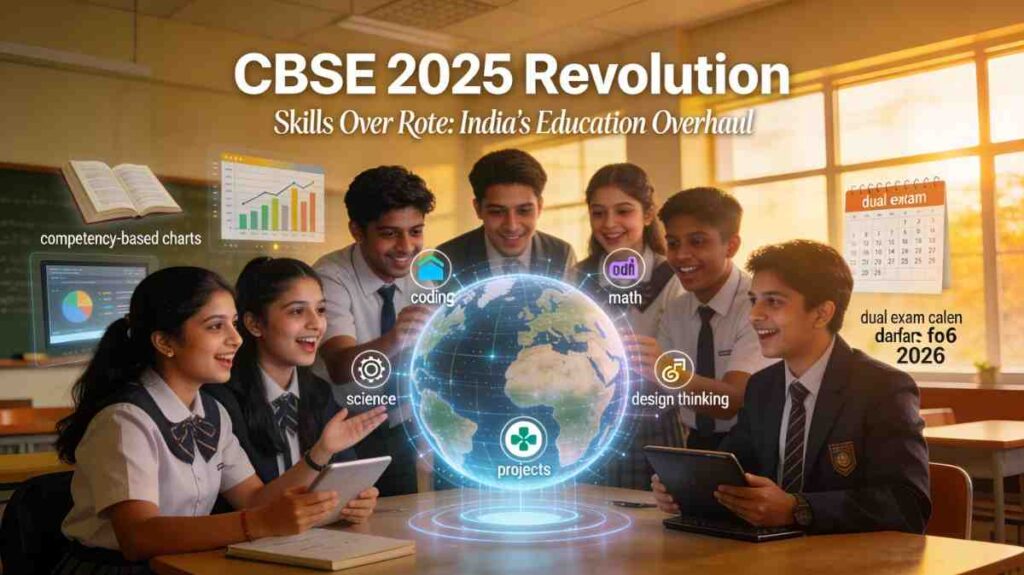
The year 2025 turned out to be one of the most transformative periods in the history of the Central Board of Secondary Education (CBSE). Instead of introducing minor adjustments, the board undertook a complete review of its traditional system—and the result was a sweeping set of reforms designed to modernize Indian schooling.
Major Reforms Introduced by CBSE in 2025
For years, students were trapped in a cycle of rote learning, rigid subject combinations, and high-stakes final exams. But CBSE realized that such an approach no longer served the needs of today’s learners, who must navigate a more dynamic, skill-driven world.
To meet those demands, the board implemented changes that touched nearly every corner of school life—from curriculum design and subject selection to assessment patterns, documentation, and exam frequency. The vision was simple yet profound: create a learning ecosystem that values understanding and application over memorization.
Curriculum Redesign for 2025–26
The first major step came with a refreshed curriculum. The board trimmed bulky chapters and shifted toward competency-based learning. The focus moved to:
-
Practical, project-oriented education rooted in real-life experiences.
-
Technology integration across subjects.
-
Interdisciplinary connections that blend concepts from different fields.
This approach encourages students to “learn by understanding” rather than simply repeating what they’ve memorized.
Flexible Subject Choices
A long-standing concern among Class 10 students was finally addressed. Those who opted for Basic Mathematics (Code 241) can now choose Mathematics Standard (Code 041) in Class 11. Earlier, this transition was not allowed, leaving students restricted in their future studies. This reform grants learners the flexibility to align their academic paths with their interests and goals.
Exams That Evaluate Skills, Not Memory
The new examination model prioritizes analytical thinking and real-world application. Papers now include MCQs, case-based scenarios, and data interpretation questions. The goal is to reward conceptual clarity and reasoning rather than short-term cramming.
Greater Weightage for Internal Assessments
To reduce the pressure of a single final exam, CBSE increased the internal assessment component to 40%, leaving 60% for the board exam. This continuous evaluation system promotes consistent engagement throughout the year.
Expansion of Skill-Based Subjects
Recognizing the growing link between education and employability, CBSE broadened its skill education portfolio. New or updated subjects include Design Thinking, Electronics & Hardware, Land Transportation Associate, and Physical Activity Training. These additions bridge the gap between classroom learning and real-world skills.
Key Administrative and Structural Changes
Two Board Exams from 2026
Starting 2026, Class 10 students will take board exams twice a year. The first attempt will be mandatory, while the second will offer an optional improvement chance. The policy aims to lower stress and provide flexibility for better performance.
APAAR ID Becomes Mandatory
Every student’s academic record must now be linked to their APAAR ID—a unique digital identity that stores all learning credentials. This ensures smoother data management during examinations, admissions, and transfers.
Stronger Data Verification
To minimize errors in personal and academic details, CBSE introduced a new verification slip system. Schools and parents must carefully confirm each student’s information before final submission, helping to avoid issues during board processing.
Wider Digital Evaluation
Digital checking of exam papers expanded to more subjects in 2025. On-screen marking has improved accuracy, reduced result processing time, and minimized human error. Following successful pilots, CBSE plans to extend this to all subjects gradually.
New Answer-Writing Guidelines for Class 10
From 2026, strict section-wise answering rules will apply in Science and Social Science papers:
-
Science: Separate sections for Physics, Chemistry, and Biology.
-
Social Science: Independent sections for History, Geography, Political Science, and Economics.
Students writing answers in the wrong section risk losing marks—even if the content is correct. Hence, schools have been advised to train students in this format during pre-board and school-level exams.
Also Read:
- NCERT Solutions for Class 10 Social Science History Chapter 3 Nationalism in India
- NCERT Solutions for Class 10 English First Flight Chapter 3 Two Stories About Flying
- CBSE Class 10 Modals: Rules, Examples, and Practice
- NCERT CBSE Class 10 SST Chapter on Forest and Wildlife Resources
- CBSE Class 10 Science Chemical Reactions and Equations Handwritten Notes
- CBSE Class 10 English Tenses Handwritten Notes PDF
- CBSE Class 10 Social Science resource and development notes in PDF
- Class 10 Economics Chapter 2 Development Handwritten Notes
- Class 10 Civics Chapter 1 Power Sharing Handwritten Notes PDF
- CBSE Class 10 English Important Extra Questions with Answers
- Maths Formulas for Class 10 pdf free download
Homepage |
Click Here |
Official Website |
Click Here |
Join Whatsapp |
Click Here |